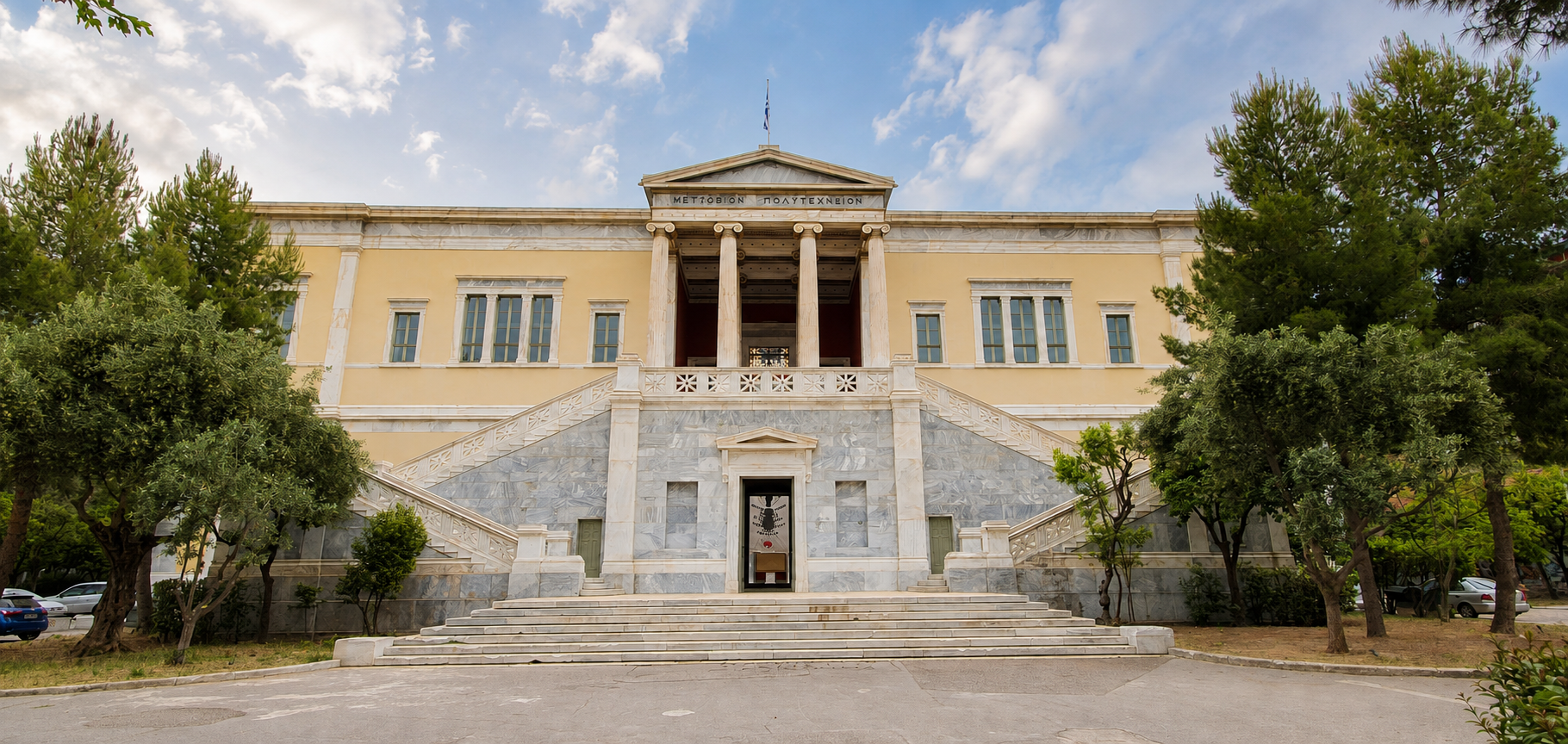
Just a short walk from Ivélia, on Patission Street, stands one of the most meaningful landmarks of modern Athens: the historic complex of the National Technical University of Athens, known to Greeks simply as the Polytechnio.
Founded in 1837, the National Technical University of Athens is Greece’s oldest technical university. It moved to its monumental Patission Street complex in 1871, where the neoclassical Averof Building—designed by architect Lysandros Kaftantzoglou—became an important part of the city’s architectural and academic identity.
Today, the historic campus remains home to the School of Architecture, continuing a long tradition of education, creativity and public dialogue.
A Symbol of Democracy
The Polytechnic holds a profound place in modern Greek history.
In November 1973, students occupied the campus in protest against the military dictatorship that had ruled Greece since 1967. Their calls for “Bread, Education, Freedom” reached far beyond the university gates, drawing people into the surrounding streets.
During the night of 17 November, a military tank broke through the main gate. The uprising was violently suppressed, yet it became an enduring symbol of democracy, courage and resistance. Every year, people return to the Polytechnic to leave flowers and honour its memory.
A Story That Lives in My Family
For me, the Polytechnic is not only a historic monument. Its story is also part of my family’s memory.
My parents experienced those days in Athens. My mother, who is no longer with us, used to tell me about hearing the tanks moving down the road. I still remember the way she described their heavy sound, the sensation of the ground trembling beneath her feet, and how she later walked to the Polytechnic herself.
Her words have stayed with me. They transformed an event from a history book into something deeply personal—a memory passed from her life into mine.
Years later, I spent time at the Polytechnic too, although I studied at the University of Piraeus. I attended a seminar there and often sat in its courtyard with friends who were students at the university.
The circumstances were entirely different, of course. Yet while talking, studying and sharing ordinary student moments in that courtyard, I could feel that this was more than a university campus. It was a place where history—and my mother’s story—had never completely left.
More Than a Building
The Polytechnic connects the intellectual life of Athens with its collective memory. Its courtyards and neoclassical buildings stand between Exarchia and the National Archaeological Museum, surrounded by the energy of Patission Street.
When staying at Ivélia, you are close enough to encounter this part of Athens on foot—not as a distant chapter in a history book, but as part of the living city.
Pause for a moment outside its historic gates. Behind them lies a story of education, architecture, youth and the continuing value of freedom.
Sources and Further Reading
National Technical University of Athens – History of the NTUA
National Technical University of Athens – The Patission Complex
NTUA School of Architecture – The Historic Campus and Averof Building
The family recollection in this article is based on a story the author’s late mother shared with her about her experience in Athens during the Polytechnic uprising.
Image Credit
“Facade of the Averof Building” by Yair-haklai, via Wikimedia Commons, licensed under CC BY-SA 4.0. Cropped and colour-adjusted for Ivélia. View the original image