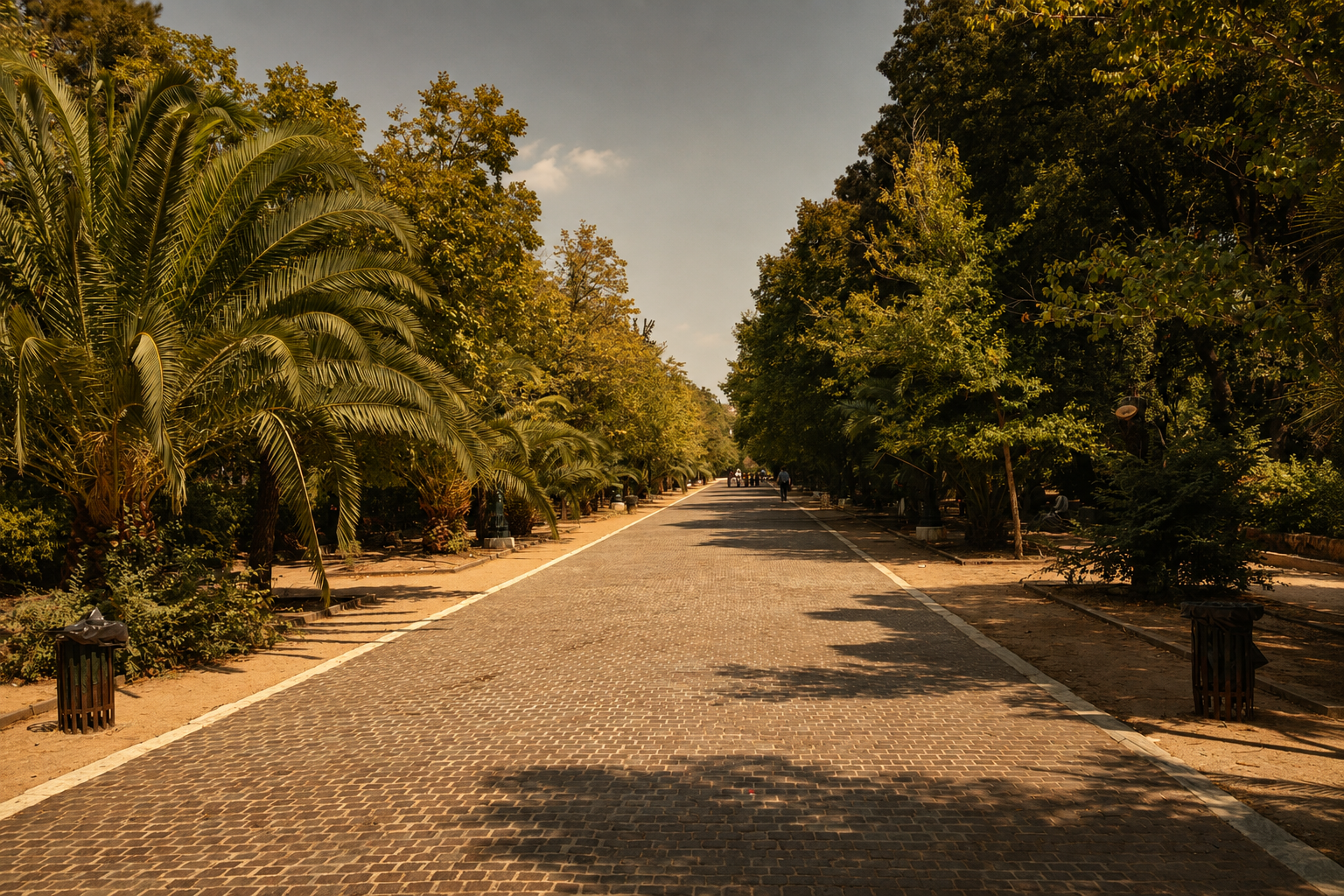
Located between Kypseli, Victoria and Exarchia, Pedion tou Areos is one of the largest public parks in Athens. Its name means the “Field of Mars”, but today it offers something much gentler: shade, open paths and a welcome sense of space within the densely built city.
A walk through history
The park took its present form in the 1930s, when it was redesigned as a public green space dedicated to the heroes of the Greek War of Independence.
Along the Avenue of Heroes, sixteen marble busts honour prominent figures of the 1821 Revolution. Elsewhere, visitors encounter monuments from different periods of modern Greek history, making a walk through the park feel like an open-air journey through the city’s past.
Yet Pedion tou Areos has never been only a historic landmark. It has always belonged to everyday Athens: children playing, people walking their dogs, runners following its paths and friends meeting beneath the trees.
A park woven into my life
As a child, I came here with my father to play on the swings, kick a football and invent games along the paved paths. Afterwards, we would sit on the grass and have a fresh juice together.
Later, I walked our dog here with my mother. During my teenage years, the park became a meeting place where my friends and I spent long afternoons talking over coffee at the café near the bridge.
As an adult, it became part of my daily route. I would cross the park on foot on my way to work on Sofokleous Street or walk through it while heading towards Exarchia. It was never simply somewhere to visit—it was woven naturally into the rhythm of my life.
A stage beneath the Athenian sky
Culture has also played an important role in the park’s identity. The historic open-air Theatro Alsos became closely associated with the glamorous entertainment scene of the 1950s and with Giorgos Oikonomidis, who helped introduce many artists to the Athenian public.
After remaining silent for many years, the theatre was revived and reopened. Today, performances, concerts and cultural events once again bring summer evenings to life beneath the trees.
The wider park has also welcomed large contemporary art installations, open-air festivals, music events and seasonal celebrations—proving that it remains not only a green refuge, but a living cultural space.
From Ivélia
Pedion tou Areos is only a short walk from Ivélia. Visit in the morning for a peaceful stroll, pause for coffee beneath the trees or return in the evening for an open-air performance.
For me, it will always hold memories of childhood, family and everyday life. For our guests, I hope it becomes a place to pause, breathe and experience Athens as locals do.