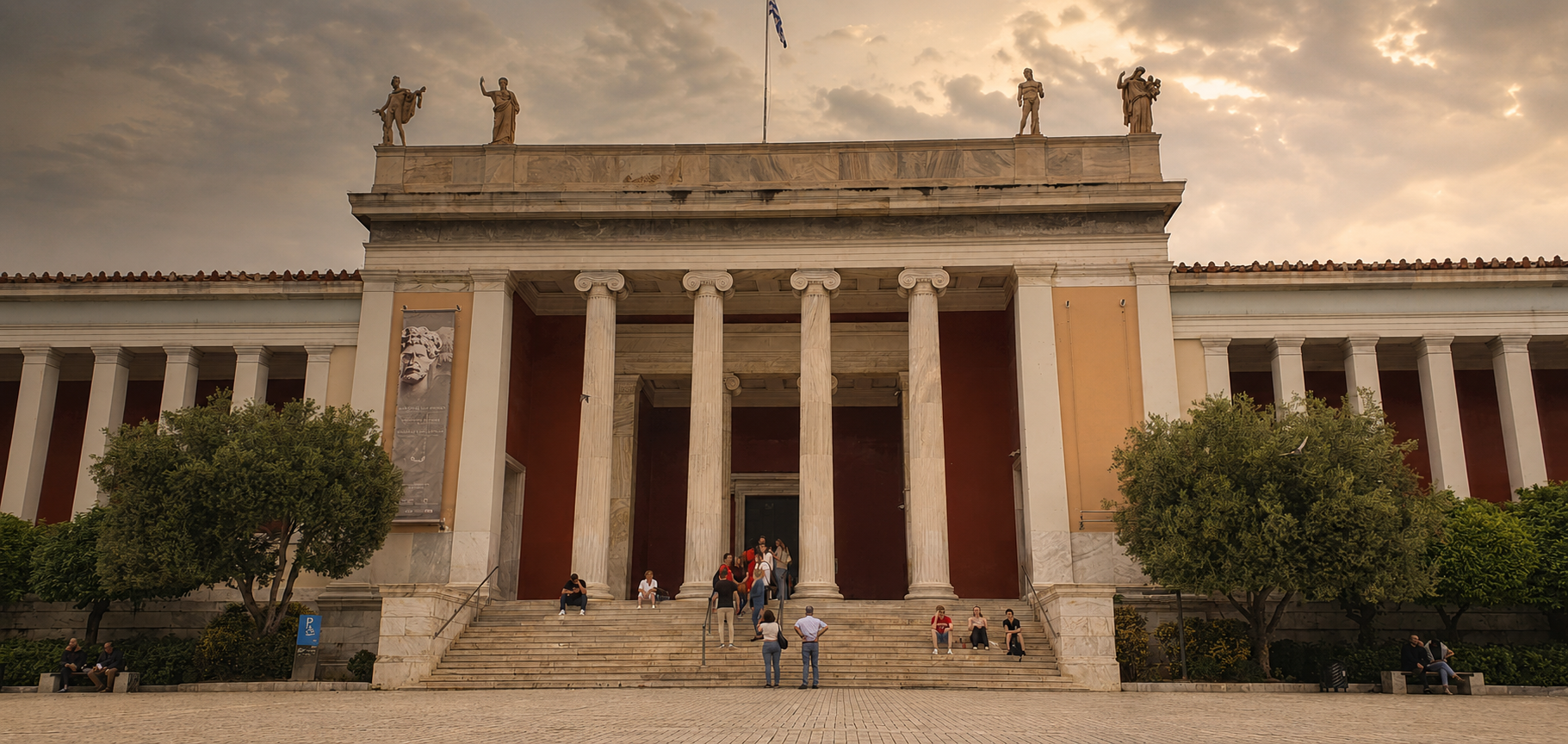
Some of Athens’ greatest treasures are not found around the Acropolis. They are housed behind the imposing neoclassical façade of the National Archaeological Museum, only a short walk from Ivélia.
Located on Patission Avenue, the museum is the largest archaeological museum in Greece and one of the world’s most important institutions devoted to ancient Greek art. Its collections bring together more than 11,000 exhibits from across the country, offering a journey from prehistory to late antiquity.
Five masterpieces not to miss
The museum’s galleries are extensive, but a memorable visit does not require seeing everything. Begin with a few of its most celebrated treasures:
The “Mask of Agamemnon”
Discovered at Mycenae by Heinrich Schliemann, this remarkable gold funerary mask dates to the 16th century BCE. Although it predates the legendary Trojan War and did not belong to the Homeric king, it remains one of the most recognisable objects of Mycenaean Greece.
The Antikythera Mechanism
Recovered from an ancient shipwreck, this complex scientific instrument was used for astronomical and calendar calculations. Its intricate system of gears continues to fascinate archaeologists, historians and engineers.
Zeus or Poseidon of Artemision
This commanding bronze statue captures a god at the moment before throwing either a thunderbolt or a trident. Its identity remains uncertain, adding to the mystery of one of the finest surviving sculptures of Classical Greece.
The Jockey of Artemision
A young rider leans forward on a galloping horse in a bronze composition filled with energy and movement. Preserved through an ancient shipwreck, it offers a rare glimpse of large-scale Greek bronze sculpture.
The Spring Fresco from Akrotiri
Red lilies and swallows fill a volcanic landscape in this extraordinary wall painting from prehistoric Thera. Created around the 16th century BCE, it feels unexpectedly fresh, joyful and alive.
More than ancient masterpieces
Beyond its permanent collections, the museum regularly hosts temporary exhibitions, educational programmes and cultural events.
Its peaceful inner courtyard is another small surprise. Filled with hundreds of plant species, it surrounds the museum café and offers a lovely place to pause before continuing through the galleries.
Ivélia’s tip for your visit
Allow at least two hours, but do not try to see everything at once. Choose the collections that interest you most, take a break in the courtyard and leave a few discoveries for another day.
A morning visit is ideal for a slower experience. Guests travelling with children may also enjoy turning the visit into a treasure hunt by choosing a handful of objects to find together.
From Ivélia
The National Archaeological Museum is one of the cultural treasures of the neighbourhood surrounding Ivélia. Its location makes it easy to enjoy an important part of ancient Greece without crossing the city or following the busiest tourist routes.
Step outside your Athenian home, walk along Patission Avenue and, within minutes, begin a journey through thousands of years of history.
Plan Your Visit
Address: 44 Patission Street, Athens
Summer 2026 opening hours: Wednesday–Monday, 08:00–20:00; Tuesday, 13:00–20:00
General admission: €20
Opening hours, ticket prices, gallery access and temporary exhibitions may change. Please consult the official museum website before visiting.
Further Reading & Official Links
Historical, practical and collection information was researched and verified through the official websites of the National Archaeological Museum and the Hellenic Ministry of Culture.
Image Credit
Hero image: Photo by Yair Haklai, via Wikimedia Commons. Licensed under CC BY-SA 4.0. Cropped and colour-adjusted for Ivélia.